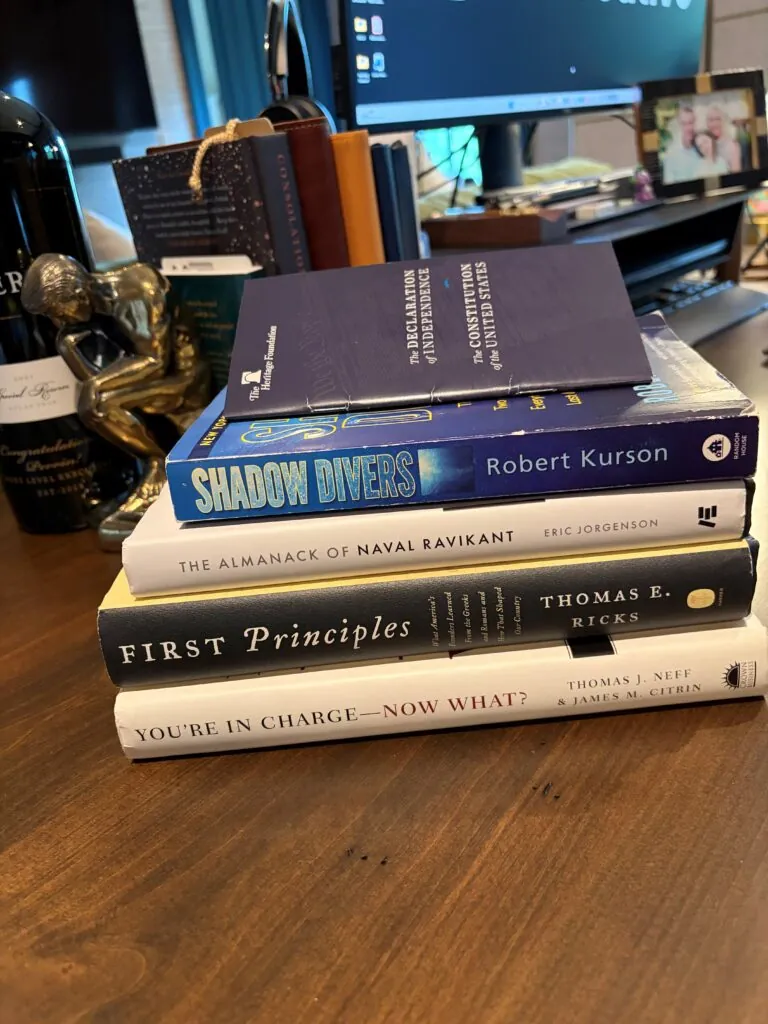
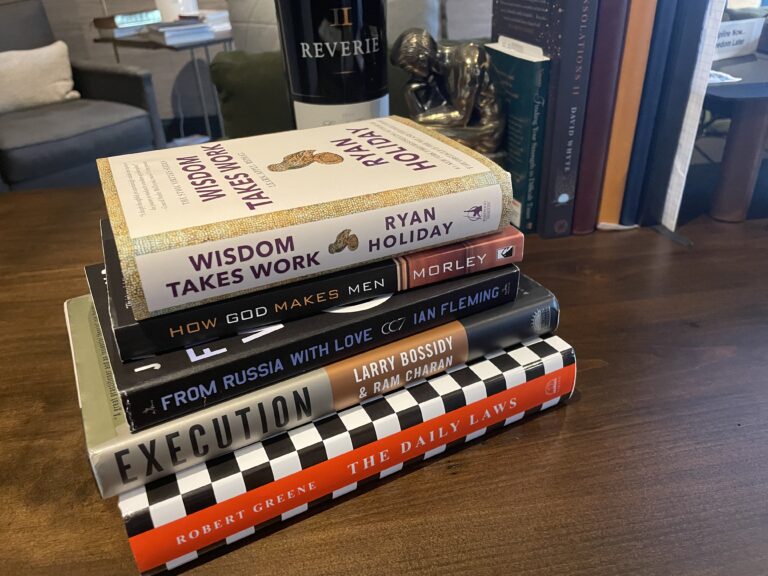
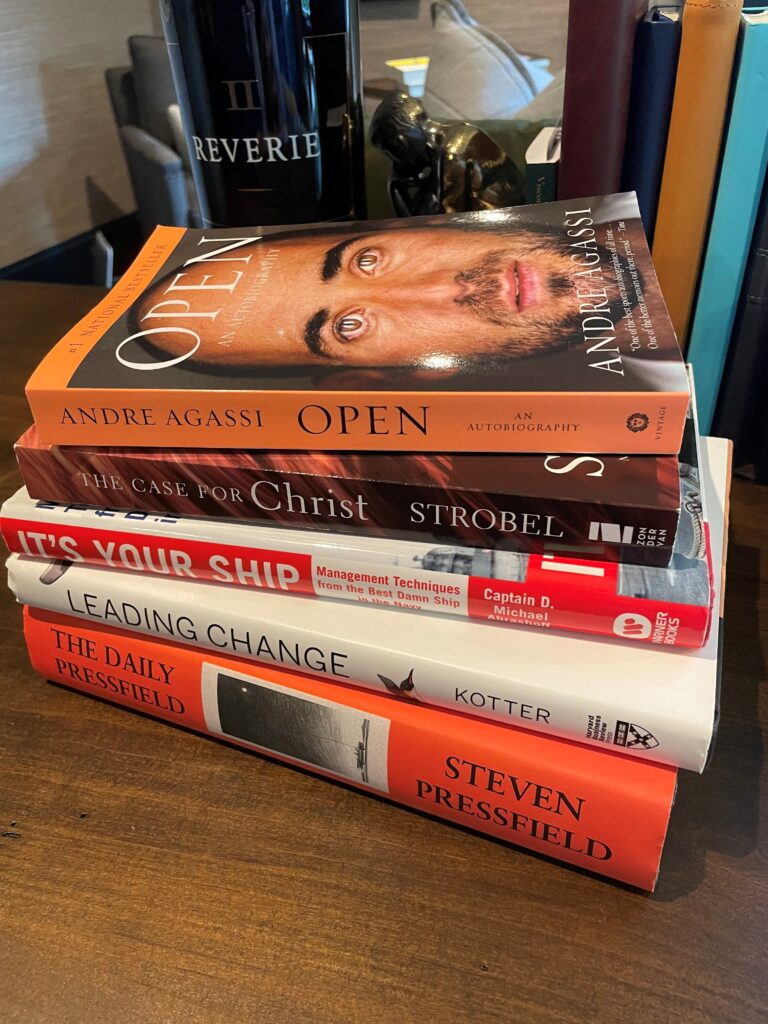
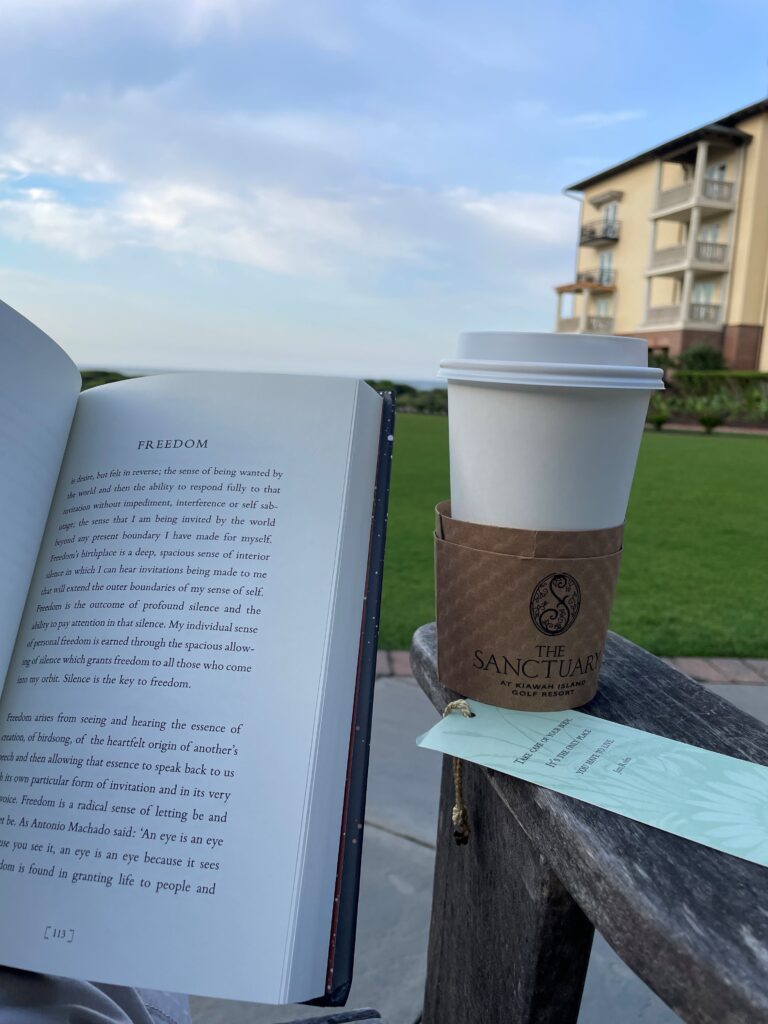
I’m not exactly sure what I was thinking over these last 90 days or so in terms of the books I wanted to read. In recent years, I’ve started to narrow my reading focus during specific times in an effort to “go deeper” into a particular subject matter instead of “going wider” across a variety of subjects. Given that general outlook, I was all of the place these last few months and took quite a heavy lift in terms of subject matter.
Harry S. Truman famously said, “Not all readers are leaders, but all leaders must be readers.”
I aspire to fall into the latter group, so I tend to view myself now as being the catalyst of my own personal and professional development. As I’m sure you can relate, being an entrepreneur is a choice we all make, so our development is an ongoing, evolutionary process where reading and study should form a cornerstone in our foundation.
I tend to average somewhere between 15 and 30 books consumed annually, depending upon their size (pages), scope (subject matter) and magnitude (exploratory thought and provocation). I turned 54 in December and if I live another 30 years, that’s only around 600 books left to consume…which doesn’t feel like many. Yet another lesson in the “quality over quantity” argument.
I’m constantly looking to add “worthy reads from credible sources” to my personal reading list, so if you have some good ones to share, please send me an email with a few of your favorites along with a sentence or two about why you liked the book(s) you’re recommending. We all “get better together.”
All of that being said, here are the best books I read in the last 90 days(ish) and would recommend them as part of your professional development and worthy of your personal evolution…
“Crossing the Unknown Sea: Work as a Pilgrimage of Identity” by David Whyte
I’ve listed several books (of both poetry and prose) by the Irish poet, David Whyte, in my “Best of…” quarterly selections, and this one is no different. “Crossing the Unknown Sea” is a challenge to anyone who has lost their sense of self in their work – and, unfortunately, I would have personally identified with that in my earlier years. Knowing what I know now, I wish I had read this book 15 years earlier.
In the western world, far too many of us allow our identity to be defined by our work, and all too often that’s as passive of a process as the sentence states. David Whyte does a masterful job of challenging our inner creativity through the use of poetry, story telling and all but direct confrontation. And it’s wonderful.
I’ll share one passage that deals with what he calls Working in a Dynamic of Conditionality:
“I’ll get to my happiness when I’m done with this project. I’ll do what I really want when the kids are through school. I’ll make the change when the house is paid off, when I’m in a better relationship, when I’ve got this amount of money in the bank, when I’m retired…
You are harvesting your identity in whatever it is you’re dedicating yourself to in the hours of the day. It’s not a passive process to work. You’re shaping an identity. It’s like practicing an instrument for 8-10 hours per day.
You’re becoming incredibly good at whoever you’re practicing at being in the hours of the day. [Ask yourself] by the way I am in my every day, who am I practicing at becoming? Do I actually want to become that person?”
As I’ve said before, David Whyte makes me see the world differently. If you give him a chance, he’ll do the same for you as well.
“The Guns of August” by Barbara Tuchman
This book won a Pulitzer Prize in 1963. It’s about the first 4 weeks of World War I (in August 1914) and takes over 700 pages to tell ALL of the stories behind the people, the agreements, the strategies, the politics, the alliances and the catalyzing events that created the conflicts that ultimately cost over 20 million people their lives.
World War I was known as “the war to end all wars” because it combined modern weapons (machine guns, artillery, tanks) with dated tactics (cavalry charges and line formation advances) that resulted in incredible carnage. I never knew that much about the depths of the First World War in terms of what all led up to it and how it almost all ended in a German victory shortly after it began.
Tuchman’s exhaustive research into almost every facet that led up to the outbreak of the initial German advance is pretty incredible. I couldn’t help but read it with a modern-day perspective and be grateful for the relative peace and tranquility that we’ve all lived under for quite an extended period of time.
“The Wisdom of the Bullfrog” by Admiral William H. McRaven
Sticking with the aspect of Military Leadership, Admiral McRaven’s books are much easier reads, but that doesn’t make them simplistic in any way. He takes his lessons from a career in the Navy SEALs and as Commander of the U.S. Special Forces, then breaks them down into actionable principles. Honestly, these are almost all applicable in some way to our businesses and ourselves if we want to model better leadership traits and behaviors.
I think the true challenge of a book like this is that it’s short, so we tend to blow through it and not really take the time we should with each individual message. Or we (incorrectly) think that it’s mostly military slogans that “don’t apply to my world.” That would be wrong. No one reding this is putting their life on the line every day, but we can and should all be able to find a place to apply timeless principles built off of successful pillars like: honor, trust, communication, commitment and contingency planning (to name several). This isn’t so much a book to be read as it one to be applied.
“Thinking Fast and Slow” by Daniel Kahneman
I had heard many people talk about this book over the last decade, but never had the courage to take it on (honestly). I was right. It took me almost 8 months to finish it, then another month to go back to review all of the notes I had taken and the passages I had highlighted. I never took Psych 102 in college…and now I know why.
All of that being said, this is a dense, heavy read that can’t be taken lightly. There’s just too much in there…but, man, is it a gamechanger. The foundational concept of the book is that our brains have two thinking systems, which Kahneman calls System One and System Two. Clearly he never let the marketing department get a hold of his manuscript. System One is “Fast” in a sense that it is intuitive, emotional and automatic based on prior experiences. System Two is “Slow” in a sense that it deliberative, calculating and complex.
He quickly shows how lazy we humans tend to be when it comes to making decisions by defaulting to System One far too often. To make matters worse, he walks through a long list of biases and heuristics that frequently indicate errors in judgement and decision making – all of which tend to create a false sense of security.
I’m not going to review the book in too much depth here because it was hard enough just to read, but what I will tell you is this: this is one of the best, most challenging books I have ever read because it forced me to get very vulnerable with the way I make decisions of consequence. I now actually think about my decision making process differently and I am far more deliberative about considering the downstream repercussions of the decision at hand. As business leaders, we would all do well to learn from that.
“The Storm Before the Calm” by George Friedman
Well, since I’ve already covered how I almost got the entire first half of my career wrong along with every last detail that cost over 20 million people their lives and the fact that my decision making is not only mostly wrong, but clearly lazy, why don’t we throw a log on the fire and dive into what’s causing the world to spin off its axis into oblivion?!
I referenced “The 4th Turning is Here” by Neil Howe in my “Best of 2024” list along with “The End of the World is Just the Beginning” by Peter Zeihan. Friedman’s “The Storm Before the Calm” is a similar geopolitical view that’s pretty congruent with those two, but each one has its own angle. Thankfully, they all point to a similar outcome from a perspective of where the United States is going to end up. All three books are absolutely worth a read, but Friedman’s is the easiest to digest of the three.
Interestingly, this book was written shortly after Donal Trump was elected President the first time. Friedman describes that as a period of discord and upheaval driven by the convergence of two cycles in American history: an 80-year “institutional cycle” and a 50-year “socio-economic cycle”. What’s unique is that we’re living through the only period in his 250-year research where the culmination of both cycles is occurring at the same point in time – all of which accentuates this “storm” that we find ourselves in.
I find these books fascinating because I tend to enjoy history in general, but when an author is able to substantiate what will likely occur in the future based off of historical (predictable) cycles, then I’m hooked. The other reason I enjoyed Friedman’s book so much was because (much like Howe and Zeihan), he gives credible guidance that we are not anywhere near the end of the United States being a global economic, political or military superpower, rather we’re at an expected phase of transition that will ultimately lead to yet another cycle of growth, opportunity and security in the future. I’ll sign up for that.
Public Service Announcement
I’m an entrepreneur like many of you. I run a small business like many of you. I marvel at corporations that change the economic landscape at scale…like many of you. Amazon is one of those businesses, but I don’t buy books there unless I have no other means of finding them.
I buy physical books because I love the practice of reading with a book in my hand and a highlighter and a pencil on my desk. I highlight passages. I make notes. I underline things. I come back and re-read passages repeatedly. I realize you can do all of the above on a Kindle, but I spend far too much of my life in front of a computer, so reading for me is a release from that obligation.
I also enjoy going into a bookstore and browsing the shelves. I enjoy the inefficient task of buying a book for myself, not simply opening a cardboard box that appears “24 hours later.” It makes me feel good to support local entrepreneurs who are trying to earn a living by sharing their love of books and taking a risk to create something that a corporation can’t. Park Road Books in Charlotte is one of those stores.
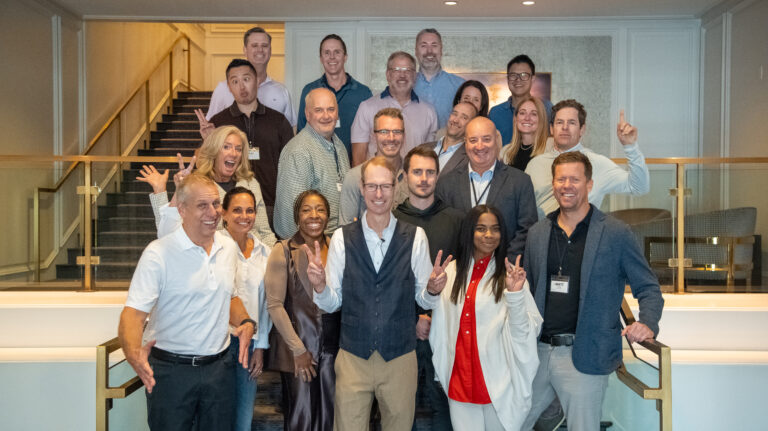
So, here’s my challenge to you. Instead of downloading your next book off of Amazon, buy a physical book from your local bookshop. Just try it once. One of the guys in the Next Level Executive program, Chris Murphy, sent me a text a few months ago saying that he took up the challenge of “buying local” and made it a great Saturday morning activity with his kids. Right on, Chris! That’s the type of memorable experience that doesn’t come in a cardboard box.
Keep going. Keep growing. And keep grinding beans.